Breaking News


Popular News




Enter your email address below and subscribe to our newsletter
 Bynewtimes
Some people treat credit cards like loans – a way to borrow now and sort things out later. But that isn’t the way credit cards should be used. Credit cards are short-term purchasing tools, designed for people who already have the money to pay for what they intend to put on the card, just not at the precise moment they tap the card.
Used correctly, they can smooth cash flow at no cost. Used incorrectly, they can become some of the most expensive debt in the financial system.
When a credit card works as intended, the mechanics are fairly straightforward.
You make a purchase today. The bank pays the seller (retail store, online store etc) immediately. Weeks later, you receive a statement. You then have a defined window – often 45 to 55 days – to repay the full amount.
If you pay the full amount by the due date, no interest is charged. You can then happily add more purchases to the card, wait 45 to 55 days, and then pay it off in full. Basically, all the credit card does is give you a ‘breather’ for a little over a month and a half. After that, interest is charged.
In this mode, a credit card is little more than delayed payment.
But this only works if you can genuinely afford what you put on the card. In other words, if you can pay off the entire amount within the 45 to 55 day window, then the credit card works for you and not against you.
Let’s say you can’t afford to pay the entire credit card debt off in the window of say 55 days. What happens next? Immediately, interest is charged on the amount you owe, and this interest will continue to accrue until you pay off your credit card debt in full.
Even if you manage to pay the minimum monthly amount (read below), interest is already accumulating and you are getting further into debt. At this point, your credit card has stop functioning as a purchasing tool and has converted into high-interest debt.
Most Australian credit cards require you to make a monthly repayment of normally:
Imagine you start with a $5,000 balance. Your minimum repayment will be in the order of:
Although that figure may feel manageable, that’s where the problem starts. Because just take a look at what’s happening in the background to your account.
Let’s say that over time, you continue to make your minimum monthly repayments. The balance begins to fall – but only slowly, because interest absorbs much of each repayment (as outlined above).
Now watch what happens next.
When the balance drops to $4,000, the minimum repayment falls from say $100 a month to $80 a month:
When the balance hits $3,000, the minimum repayment falls to $60 a month.
So just as your debt starts to shrink, your required minimum repayment shrinks with it. The problem with with this is that you are suddenly paying off your debt more slowly. So as your minimum monthly repayments shrink:
In the early years, you’re at least making visible dents in the balance. In the later years, you can be paying every month and watching the balance barely move.
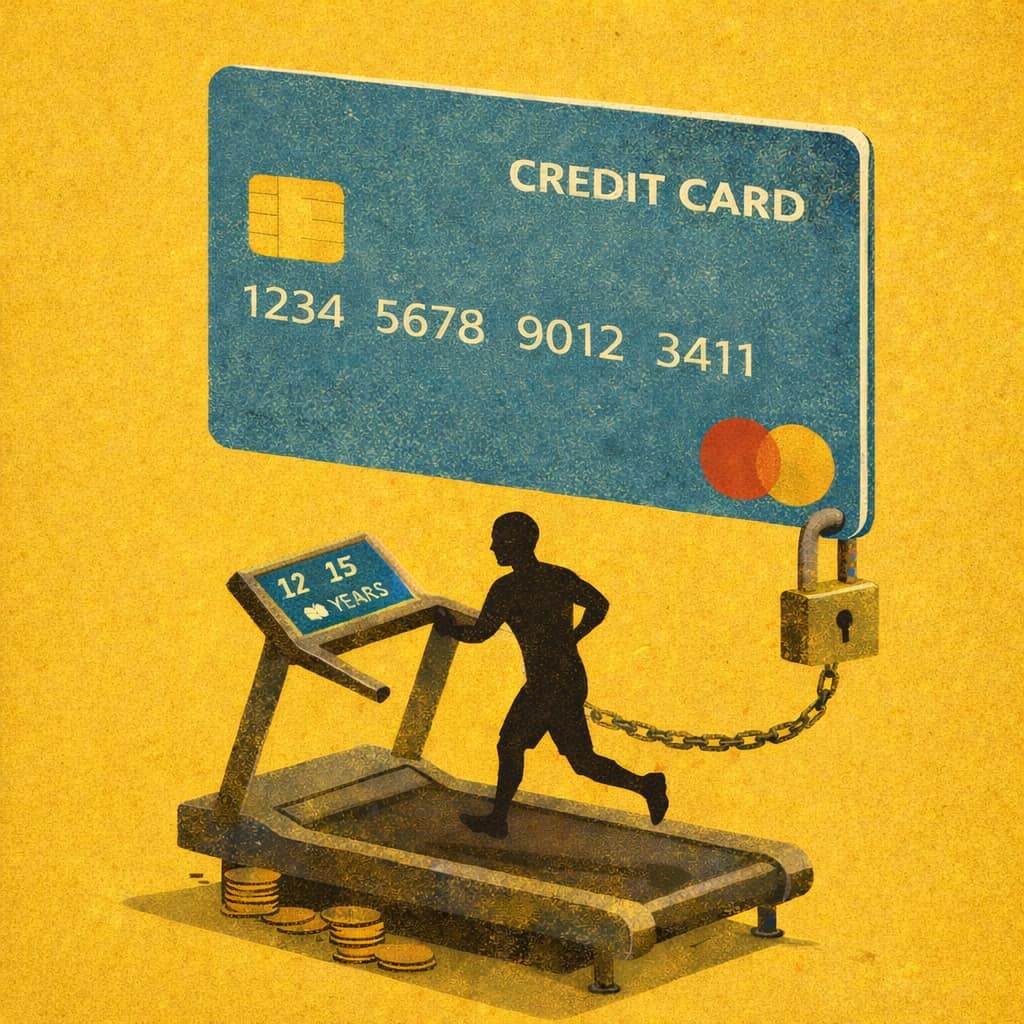
This is why the final stretch of a credit card debt often takes longer than the first half, even though the balance is smaller. This is how a debt that feels “under control” quietly stretches out for years – sometimes decades.
This is how a credit card debt that looks “under control” can quietly consume a decade or more.
Minimum monthly repayments are not designed to help you exit your credit card debt. They are primarily designed to reduce default risk for lenders (such as banks). They also are designed to encourage debt to persist over time (which maximises profits for the credit card company).
From the bank’s perspective, a slowly declining balance is stable – and profitable. From the cardholder’s perspective, it feels manageable – until you actually start to add up how much interest you are paying!
If you only ever pay the minimum, your repayments get easier – but your debt gets harder to escape.
How long does $5,000 last on minimum repayments?
Let’s assume:
You are likely looking at:
And roughly half of that is interest.
And remember, this what happens when you successfully make every monthly payment on time!

 English